

12 posts :: Page 1 of 1
I would love to do that! I need some advanced notice to get a Saturday off work, tho.......

We talked about this last night at the discussion group and decided to plan for an April 10th (mostly because of Terri and my schedules and the Easter holiday) outing. This does not mean that it's carved into stone or that we can't have more than one.
As a straw-man we decided on taking the Metro down to Union Station and taking the Art Deco walk, which is every Saturday at 10 am. This takes about 2-2.5 hours. Afterward we could meet at the plaza on Olvera St across from the Union station, do lunch, shoot up the area, then take the Metro back.
I agreed to get Metro times, costs, and contact the Conservancy about groups with cameras and tripods. This should happen this week.
That's the straw-man. Let us know if you have something else in mind.
As a straw-man we decided on taking the Metro down to Union Station and taking the Art Deco walk, which is every Saturday at 10 am. This takes about 2-2.5 hours. Afterward we could meet at the plaza on Olvera St across from the Union station, do lunch, shoot up the area, then take the Metro back.
I agreed to get Metro times, costs, and contact the Conservancy about groups with cameras and tripods. This should happen this week.
That's the straw-man. Let us know if you have something else in mind.

Here's what I've found for April 10, 2010. I haven't gotten any push back on that date so I'll press ahead with it.
Summary: There are three good walking tours on that date, all starting at 10 a.m.
http://www.laconservancey.org
- Art Deco
- Historic Core
- Downtown Renaissance
- Options are:
a) Stay in one big group or split into smaller groups to go on separate tours.
-- If we stay in one group then we will probably have to make special arrangements but might get our own custom tour.
-- If we split up then there are even more options for individuals such as hanging around Union Station/Olvera St. and self guided tours of the many interesting parts of the downtown area.
b) Travel down and back has been suggested by Metrolink but personal cars and other methods are also available.
- I would like your feedback on these, there's only six weeks to finalize this, get the word out, and make it happen.
Details:
- Tours: There are actually four walking tours scheduled for that day but I spoke with Annie, the tour leader, and she said that the Broadway tour would not be good for photography because too much of it is indoors where many of the businesses don't allow cameras. The other three work well for photographers (she's worked with many photo clubs) but tripods are discouraged because of the pace of the tours and the limited space on the sidewalks. The Art Deco tour, she said, is probably the best because they often stop in front of buildings and spend some time talking about the architecture and art work.
-- Art Deco:
--- Length: 2-2.5 hours, 1.5 miles
--- Starts at Pershing Square
--- Cost: $10/adult
-- Historic Core:
--- Length: 2.5 hours, 1.5 miles
--- Starts at Pershing Square
--- Cost $10/adult
-- Downtown Renaissance:
--- Length 2 3/4 hours, 1 1/4 miles
--- Starts at Main and 4th
--- Cost is $10/adult
-- Union Station/Olvera St:
--- Self guided
--- Historic Union Station (Google Images "union station los angeles"
--- Olvera St. with it's square, historic buildings, shops, restaurants (Google images "olvera st los angeles"
-- Other
--- Walt Disney Concert Hall
--- Cathedral of Our Lady of the Angels
--- Many other interesting and impressive sights
- Transportation:
-- Metrolink:
--- Leaves Palmdale at 6:49 a.m. and arrives at Union Station at 8:35 a.m., plenty of time to get to your starting point. Round trip fare is $16.25.
http://www.metrolinktrains.com/schedules/
--- There are trains/busses to Pershing Square which are free with your Metrolink ticket. The Downtown Renaissance tour starts only a few blocks from there.
--- The Saturday return Metrolink leaves Union Station at 2:45 p.m. and arrives at Palmdale at 4:40 p.m.
--- If these times/arrangements are not to your liking the LA Conservancy can validate your parking so you pay only $5. An additional alternative is to make arrangements so that you can take the Metrolink down with the group (there are some interesting photography opportunities on the trip) then ride back with someone, but you'll have to work that out yourselves.
- Proposed Itinerary:
-- Take the Metrolink down.
-- Split into different tours.
-- Meet back at Olvera St. about 1 p.m.to eat, chat, and take photos.
-- Wander around Ovlera St. until time to catch the Metrolink back.
Conclusion:
-- It's a long day (about 10 hours) but there's enough to see and photograph to satisfy almost anyone.
-- You'll get to photograph architecture, art, street scenes and people, culture, city life, and more.
-- By chatting with other participants and looking at what they photographed you'll have a better feel for what's available to the photographer in LA
-- You'll be more confident about scheduling your own trip/tour to downtown LA.
Let me know what you think.
Glenn Olson
<!-- e --><a href="mailto:glenn@glenn-olson.com">glenn@glenn-olson.com</a><!-- e -->
816-8278
Summary: There are three good walking tours on that date, all starting at 10 a.m.
http://www.laconservancey.org
- Art Deco
- Historic Core
- Downtown Renaissance
- Options are:
a) Stay in one big group or split into smaller groups to go on separate tours.
-- If we stay in one group then we will probably have to make special arrangements but might get our own custom tour.
-- If we split up then there are even more options for individuals such as hanging around Union Station/Olvera St. and self guided tours of the many interesting parts of the downtown area.
b) Travel down and back has been suggested by Metrolink but personal cars and other methods are also available.
- I would like your feedback on these, there's only six weeks to finalize this, get the word out, and make it happen.
Details:
- Tours: There are actually four walking tours scheduled for that day but I spoke with Annie, the tour leader, and she said that the Broadway tour would not be good for photography because too much of it is indoors where many of the businesses don't allow cameras. The other three work well for photographers (she's worked with many photo clubs) but tripods are discouraged because of the pace of the tours and the limited space on the sidewalks. The Art Deco tour, she said, is probably the best because they often stop in front of buildings and spend some time talking about the architecture and art work.
-- Art Deco:
--- Length: 2-2.5 hours, 1.5 miles
--- Starts at Pershing Square
--- Cost: $10/adult
-- Historic Core:
--- Length: 2.5 hours, 1.5 miles
--- Starts at Pershing Square
--- Cost $10/adult
-- Downtown Renaissance:
--- Length 2 3/4 hours, 1 1/4 miles
--- Starts at Main and 4th
--- Cost is $10/adult
-- Union Station/Olvera St:
--- Self guided
--- Historic Union Station (Google Images "union station los angeles"
--- Olvera St. with it's square, historic buildings, shops, restaurants (Google images "olvera st los angeles"
-- Other
--- Walt Disney Concert Hall
--- Cathedral of Our Lady of the Angels
--- Many other interesting and impressive sights
- Transportation:
-- Metrolink:
--- Leaves Palmdale at 6:49 a.m. and arrives at Union Station at 8:35 a.m., plenty of time to get to your starting point. Round trip fare is $16.25.
http://www.metrolinktrains.com/schedules/
--- There are trains/busses to Pershing Square which are free with your Metrolink ticket. The Downtown Renaissance tour starts only a few blocks from there.
--- The Saturday return Metrolink leaves Union Station at 2:45 p.m. and arrives at Palmdale at 4:40 p.m.
--- If these times/arrangements are not to your liking the LA Conservancy can validate your parking so you pay only $5. An additional alternative is to make arrangements so that you can take the Metrolink down with the group (there are some interesting photography opportunities on the trip) then ride back with someone, but you'll have to work that out yourselves.
- Proposed Itinerary:
-- Take the Metrolink down.
-- Split into different tours.
-- Meet back at Olvera St. about 1 p.m.to eat, chat, and take photos.
-- Wander around Ovlera St. until time to catch the Metrolink back.
Conclusion:
-- It's a long day (about 10 hours) but there's enough to see and photograph to satisfy almost anyone.
-- You'll get to photograph architecture, art, street scenes and people, culture, city life, and more.
-- By chatting with other participants and looking at what they photographed you'll have a better feel for what's available to the photographer in LA
-- You'll be more confident about scheduling your own trip/tour to downtown LA.
Let me know what you think.
Glenn Olson
<!-- e --><a href="mailto:glenn@glenn-olson.com">glenn@glenn-olson.com</a><!-- e -->
816-8278
What is Art Deco:
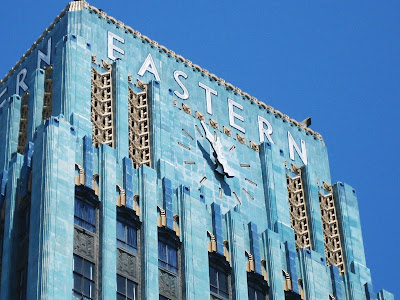
"Art Deco was a popular international art design movement from 1925 until the 1940s, affecting the decorative arts such as architecture, interior design and industrial design, as well as the visual arts such as fashion, painting, the graphic arts and film. At the time, this style was seen as elegant, glamorous, functional and modern." - Wikipedia
Art Deco, as a style, has been applied to architecture, paintings, sculptures, and decorations. Hopefully we'll see many examples of each of these on our walk and you'll want to get photos of each application. A good place to preview the Art Deco walk online is at http://laplaces.blogspot.com/2009/07/downtown-art-deco.html. This site includes a google map of the locations we will visit. A couple more web sites you may want to visit are:
http://www.decopix.com/New%20Site/Pages/Directory%20Pages/Classic_Deco_dir.html
http://www.therealgalveston.com/Architecture.html
To spot art deco you should look for the geometric shapes, sweeping curves, steps, chevrons, sunbursts, and radiator grills. Our Docent (guide) will point out those characteristics of art deco and you may want to take photos at different levels of detail. For example, a particular building may be designed in the art deco style. On that building the windows and doorways will also be in the art deco style, but having their own unique details. Each set of doors, possibly unique in the entire world, may have a number of decorative motifs such as chevrons, sunbursts, and stylized portraits. The building, doorways, doors, and each motif deserves its own photo. Bring spare batteries and lots of memory (or film).

What to wear:
I can't predict the weather but L.A. in April is usually mild. Check the weather the day before going down but typically, if it's a nice sunny day, a light sweater or jacket is all you'll need.
Wear good walking shoes. Five of the nine locations we will visit are within a block of Pershing Square with the other four no more than four city blocks away and fairly close together.

"Portrait of a Young Girl in a Green Dress," 1929 oil on canvas, by Lempicka's
What to bring:
We'll be leaving Palmdale at 6:49 a.m. and arriving at Union Station about 8:35. The Red Line leaves about every 5 minutes and takes 5 minutes to get to Pershing Square (the second stop) so we should be there well before 9 a.m. This will give us about an hour to grab some coffee (espresso, latte, etc) and something to eat before the tour starts at 10 a.m. I Googled the street scenes and there are several Delis within a block and possibly fast food and restaurants also. The tour is about 2 1/2 hours so I'll be carrying water and snacks in my backpack where my telephoto lens usually goes, though we'll probably pass many food outlets during the walk. After the tour it will likely take us 15-20 minutes to reach the restaurants on Olvera St. I don't know about anyone else but I plan my trips around my stomach.
Because we'll be downtown you'll probably want a relatively wide angle lens. I'll be using my kit lens, 18-55 mm, so that I can capture the buildings as well as the fine decorations. If you want shots of building-top details you may want to bring a medium telephoto. I'll be packing my 70-210 mm. lens but I doubt that I'll use it.
I'll be distributing handouts with maps, schedules, and phone numbers. You should keep these with you in case you get separated from the group.

PC case in the Art Deco style
"Art Deco was a popular international art design movement from 1925 until the 1940s, affecting the decorative arts such as architecture, interior design and industrial design, as well as the visual arts such as fashion, painting, the graphic arts and film. At the time, this style was seen as elegant, glamorous, functional and modern." - Wikipedia
Art Deco, as a style, has been applied to architecture, paintings, sculptures, and decorations. Hopefully we'll see many examples of each of these on our walk and you'll want to get photos of each application. A good place to preview the Art Deco walk online is at http://laplaces.blogspot.com/2009/07/downtown-art-deco.html. This site includes a google map of the locations we will visit. A couple more web sites you may want to visit are:
http://www.decopix.com/New%20Site/Pages/Directory%20Pages/Classic_Deco_dir.html
http://www.therealgalveston.com/Architecture.html
To spot art deco you should look for the geometric shapes, sweeping curves, steps, chevrons, sunbursts, and radiator grills. Our Docent (guide) will point out those characteristics of art deco and you may want to take photos at different levels of detail. For example, a particular building may be designed in the art deco style. On that building the windows and doorways will also be in the art deco style, but having their own unique details. Each set of doors, possibly unique in the entire world, may have a number of decorative motifs such as chevrons, sunbursts, and stylized portraits. The building, doorways, doors, and each motif deserves its own photo. Bring spare batteries and lots of memory (or film).
What to wear:
I can't predict the weather but L.A. in April is usually mild. Check the weather the day before going down but typically, if it's a nice sunny day, a light sweater or jacket is all you'll need.
Wear good walking shoes. Five of the nine locations we will visit are within a block of Pershing Square with the other four no more than four city blocks away and fairly close together.
"Portrait of a Young Girl in a Green Dress," 1929 oil on canvas, by Lempicka's
What to bring:
We'll be leaving Palmdale at 6:49 a.m. and arriving at Union Station about 8:35. The Red Line leaves about every 5 minutes and takes 5 minutes to get to Pershing Square (the second stop) so we should be there well before 9 a.m. This will give us about an hour to grab some coffee (espresso, latte, etc) and something to eat before the tour starts at 10 a.m. I Googled the street scenes and there are several Delis within a block and possibly fast food and restaurants also. The tour is about 2 1/2 hours so I'll be carrying water and snacks in my backpack where my telephoto lens usually goes, though we'll probably pass many food outlets during the walk. After the tour it will likely take us 15-20 minutes to reach the restaurants on Olvera St. I don't know about anyone else but I plan my trips around my stomach.
Because we'll be downtown you'll probably want a relatively wide angle lens. I'll be using my kit lens, 18-55 mm, so that I can capture the buildings as well as the fine decorations. If you want shots of building-top details you may want to bring a medium telephoto. I'll be packing my 70-210 mm. lens but I doubt that I'll use it.
I'll be distributing handouts with maps, schedules, and phone numbers. You should keep these with you in case you get separated from the group.
PC case in the Art Deco style
Here is the Word file for handout which will be distributed at the meeting tonight.
http://www.glenn-olson.com/photos/bucket/deco2.doc
http://www.glenn-olson.com/photos/bucket/deco2.doc
Todays Showcase in the AV Press has their front page article on the Union Station tour.
Cheryl Ross
Cheryl Ross
Here ya go..................................................................... (OCR)

Last of the Great Railway Stations
Tours of Los Angeles landmark offer glimpse into citys transportation past.
by Jim Skeen
Valley Press Business Editor
As new members of the Los Angeles Conservancy, my fiancee and I were offered a free walking tour of Los Angeles Union Station — a chance to see one of the city's great jewels upclose.
Opened in 1939, Union Station is simply one of the most beautiful buildings in all of Los Angeles and has been described as "the last of the great railway stations." For someone seeing it for the first time, it is a jaw-dropping experience.

"It is just a magnificent thing," said Anne Laskey, program manager at the conservancy. "L.A. doesn't have many grand spaces, but this is one of them. It has a sense of spaciousness and grandeur."
Over 1,000 people a year take the conservancy's tour of the station, which has been offered since 1991. The docents work from a script Laskey helped develop, but each brings their own interest to the tour, whether railroad history, sociology or Los Angeles history.
"Each docent brings their own voice to the tour — which is a good thing," Laskey said. "They will bring to it their own sense of history."
We met up with our tour group in the station's south patio and our guide led us out to view the station's main entrance. Designed by John and Donald Parkinson, the same father-and-son team that designed the Los Angeles Memorial Coliseum, the station is a mix of Spanish Colonial Revival, art deco and Moorish architecture, disparate styles blended together in a sublime manner.
The facade is Spanish Colonial, looking very much like the California missions with its red tile roofs,smooth white plaster walls and arched windows. The Moorish influences can been seen in the clock tower, high-arched windows and an eight-pointed star desig^jf: at the entrance — a symbol, our guide pointed out, repeated in other portions of the structure.
The art deco elements are first seen in the Union Station marquee over the entrance, with its emphasis on horizontal lines, giving it a sense of movement. Horizontal and zig-zag art deco lines are seen throughout" the interior of the station.
The station's construction was marked with controversy, our guide said. It was created to consolidate three railroads, which had their own depots and their own maze of rail lines through streets, clogging the city's burgeoning traffic.
But the station was fought by the railroads, each wanting to retain their own stations, resulting in several years of litigation that was ultimately resolved by the U.S. Supreme Court.
The location selected for the station was then the heart of Chinatown, which mean families and businesses had to be uprooted, many with little notice. A boundary line marking where the community once was has since been incorporated into one of the station's patios.
As we approached the main entrance, our guide asked us to imagine being a visitor in the 1940s — perr haps a serviceman coming into the city or about to head east for an assignment. In the 1940s, the station was bustling with rail passengers; many of them servicemen.
"It was designed as the gateway to Los Angeles," Las-key said. "This would have been their (passengers') first encounter with Los Angeles. This is how L.A. would have greeted you."
To the visitor's left is the ticket concourse, no longer in use except for movie and wedding rentals. The room is still grand with a high ceiling 52 feet up with beams painted to look like wood. There are six 10-foot-diame-ter, 3,000-pound chandeliers hanging from the ceiling.
The 115-foot-long walnut ticket counter is still there, a ghost of the station's heydays.
The 140-foot-long waiting room is remarkably quiet despite its cavernous size, thanks to acoustic tiling. In the tour program, the conservancy describes the room as featuring a wainscot of multi-colored Spanish tile below panels of sienna-colored travertine, punctuated by small ornamental tiles.
The red tile floor is highlighted by a marble pathway laid in geometric patterns down a centerline, which guides visitors through the station.
"It's a warm kind of architecture," Laskey said. "It's a place you want to stay awhile."
The station is in terrific shape for its age, Laskey said. In the 1970s, when its use declined, it benefitted from being ignored. By the time its use starting building back up, thanks to Metrolink and the city's Metro rail system, there was a growing awareness of preservation.
The condition of the building has benefitted from steady ownership. Its owner, Catellus, is a real estate arm of the railroads that the station originally served.
Gatellus has been respectful of the building's past. During a major renovation a few years back, the company left the ticket concourse intact. The company did take down a wall of gateways, but retained a couple of them so visitors could see how the structure once looked. Marquees added to the parking lot were done in an art deco style that mirrored the station's architecture.
Public art highlights the tour stop at the east portal to the station. Above an escalator that leads to the train and subway concourse is a work that appears to be nothing more than moving slats of light.
But if a visitor looks long enough, the work appears to be a moving train with famous passengers, including movie stars, Vincent Van Gogh and George Washington, looking out the windows.
At the bottom of the escalator is a mural depiciting travelers in the region over the centuries, from Spanish explorers to stagecoach passengers to actress Carole Lombard sitting on a suitcase.
At one end of the east portal lobby is a giant aquarium with historical figures etched into the glass, one of them appearing to be James Dean. The aquarium holds sea life found off the California coast.
Also in the lobby is a work honoring the city's history, a bench that incorporates a symbolic meandering Los Angeles River in its design. At one end is a "mountain" made of artifacts of the original Chinatown found during excavation work, including bottles, crockery and even a set of false teeth.
Our tour was capped with a peek inside the former Harvey House restaurant, which, like the ticket concourse, is now closed, except for movie and wedding rentals, and is very much a symbol of bygone days.
The restaurant was designed by Mary Goiter, whom biographer Arnold Berke described as "the best known unknown architect in the a world." Like the station, the restaurs rant has Spanish Colonial and art £ deco elements, but it also reflects Colter's interest in the American Southwest with the floor tile resembling a Navajo rug.
The main room is dominated by a U-shaped bar. Our guide points out that the spots where stools were once fastened can still be seen on the floor around the bar.
To the side is another bar and a series of booths, each with a mirror on the wall, arranged in an asymmetric pattern. It is possible, our guide said, to find a spot at the end of the booths where a person's reflection would be seen in every mirror. Unfortunately, he was not able to find it.

The Harvey House restaurant stopped operating in the 1960s. Today's passengers can find food at a couple of snack bars or, for those unafraid to let some sunshine into their wallets, the fabulous Traxx restaurant.
Got the bug yet?
Visit http://www.lpaphotography.org/Calendar/ClubEvents/fieldtrips/04GrandStation/index.html
Last of the Great Railway Stations
Tours of Los Angeles landmark offer glimpse into citys transportation past.
by Jim Skeen
Valley Press Business Editor
As new members of the Los Angeles Conservancy, my fiancee and I were offered a free walking tour of Los Angeles Union Station — a chance to see one of the city's great jewels upclose.
Opened in 1939, Union Station is simply one of the most beautiful buildings in all of Los Angeles and has been described as "the last of the great railway stations." For someone seeing it for the first time, it is a jaw-dropping experience.
"It is just a magnificent thing," said Anne Laskey, program manager at the conservancy. "L.A. doesn't have many grand spaces, but this is one of them. It has a sense of spaciousness and grandeur."
Over 1,000 people a year take the conservancy's tour of the station, which has been offered since 1991. The docents work from a script Laskey helped develop, but each brings their own interest to the tour, whether railroad history, sociology or Los Angeles history.
"Each docent brings their own voice to the tour — which is a good thing," Laskey said. "They will bring to it their own sense of history."
We met up with our tour group in the station's south patio and our guide led us out to view the station's main entrance. Designed by John and Donald Parkinson, the same father-and-son team that designed the Los Angeles Memorial Coliseum, the station is a mix of Spanish Colonial Revival, art deco and Moorish architecture, disparate styles blended together in a sublime manner.
The facade is Spanish Colonial, looking very much like the California missions with its red tile roofs,smooth white plaster walls and arched windows. The Moorish influences can been seen in the clock tower, high-arched windows and an eight-pointed star desig^jf: at the entrance — a symbol, our guide pointed out, repeated in other portions of the structure.
The art deco elements are first seen in the Union Station marquee over the entrance, with its emphasis on horizontal lines, giving it a sense of movement. Horizontal and zig-zag art deco lines are seen throughout" the interior of the station.
The station's construction was marked with controversy, our guide said. It was created to consolidate three railroads, which had their own depots and their own maze of rail lines through streets, clogging the city's burgeoning traffic.
But the station was fought by the railroads, each wanting to retain their own stations, resulting in several years of litigation that was ultimately resolved by the U.S. Supreme Court.
The location selected for the station was then the heart of Chinatown, which mean families and businesses had to be uprooted, many with little notice. A boundary line marking where the community once was has since been incorporated into one of the station's patios.
As we approached the main entrance, our guide asked us to imagine being a visitor in the 1940s — perr haps a serviceman coming into the city or about to head east for an assignment. In the 1940s, the station was bustling with rail passengers; many of them servicemen.
"It was designed as the gateway to Los Angeles," Las-key said. "This would have been their (passengers') first encounter with Los Angeles. This is how L.A. would have greeted you."
To the visitor's left is the ticket concourse, no longer in use except for movie and wedding rentals. The room is still grand with a high ceiling 52 feet up with beams painted to look like wood. There are six 10-foot-diame-ter, 3,000-pound chandeliers hanging from the ceiling.
The 115-foot-long walnut ticket counter is still there, a ghost of the station's heydays.
The 140-foot-long waiting room is remarkably quiet despite its cavernous size, thanks to acoustic tiling. In the tour program, the conservancy describes the room as featuring a wainscot of multi-colored Spanish tile below panels of sienna-colored travertine, punctuated by small ornamental tiles.
The red tile floor is highlighted by a marble pathway laid in geometric patterns down a centerline, which guides visitors through the station.
"It's a warm kind of architecture," Laskey said. "It's a place you want to stay awhile."
The station is in terrific shape for its age, Laskey said. In the 1970s, when its use declined, it benefitted from being ignored. By the time its use starting building back up, thanks to Metrolink and the city's Metro rail system, there was a growing awareness of preservation.
The condition of the building has benefitted from steady ownership. Its owner, Catellus, is a real estate arm of the railroads that the station originally served.
Gatellus has been respectful of the building's past. During a major renovation a few years back, the company left the ticket concourse intact. The company did take down a wall of gateways, but retained a couple of them so visitors could see how the structure once looked. Marquees added to the parking lot were done in an art deco style that mirrored the station's architecture.
Public art highlights the tour stop at the east portal to the station. Above an escalator that leads to the train and subway concourse is a work that appears to be nothing more than moving slats of light.
But if a visitor looks long enough, the work appears to be a moving train with famous passengers, including movie stars, Vincent Van Gogh and George Washington, looking out the windows.
At the bottom of the escalator is a mural depiciting travelers in the region over the centuries, from Spanish explorers to stagecoach passengers to actress Carole Lombard sitting on a suitcase.
At one end of the east portal lobby is a giant aquarium with historical figures etched into the glass, one of them appearing to be James Dean. The aquarium holds sea life found off the California coast.
Also in the lobby is a work honoring the city's history, a bench that incorporates a symbolic meandering Los Angeles River in its design. At one end is a "mountain" made of artifacts of the original Chinatown found during excavation work, including bottles, crockery and even a set of false teeth.
Our tour was capped with a peek inside the former Harvey House restaurant, which, like the ticket concourse, is now closed, except for movie and wedding rentals, and is very much a symbol of bygone days.
The restaurant was designed by Mary Goiter, whom biographer Arnold Berke described as "the best known unknown architect in the a world." Like the station, the restaurs rant has Spanish Colonial and art £ deco elements, but it also reflects Colter's interest in the American Southwest with the floor tile resembling a Navajo rug.
The main room is dominated by a U-shaped bar. Our guide points out that the spots where stools were once fastened can still be seen on the floor around the bar.
To the side is another bar and a series of booths, each with a mirror on the wall, arranged in an asymmetric pattern. It is possible, our guide said, to find a spot at the end of the booths where a person's reflection would be seen in every mirror. Unfortunately, he was not able to find it.
The Harvey House restaurant stopped operating in the 1960s. Today's passengers can find food at a couple of snack bars or, for those unafraid to let some sunshine into their wallets, the fabulous Traxx restaurant.
Got the bug yet?
Visit http://www.lpaphotography.org/Calendar/ClubEvents/fieldtrips/04GrandStation/index.html

I spoke with the folks at the LA Conservancy yesterday and they will have two docents (guides) available for the Art Deco tour with plenty of spaces still available. Anyone who hasn't purchased their tickets yet can still do so and join us on this field trip.
FYI - Lee and I will be getting on the train at the Lancaster station. We'll phone Glenn to let him know what car we end up on. We just didn't want to drive all the way to Palmdale, when the Lancaster station is just 3 miles down the Blvd.  So for those in Lancaster who wish to do the same, come join us.
So for those in Lancaster who wish to do the same, come join us.
Follow-up Report (from my perspective):
Hooray, a success. True, only six eventually made it but we came back with a wide variety of photos and a wealth of information about how to get even more.
Many thanks to all those who participated in coming up with the idea, planning it out, reviewing the flyers and postings, and getting the word out. My name may have been on this field trip as the lead but many others participated. Also, many thanks to the LA Conservancy.
Things that went well: The trip went smoothly. We all knew where to go, where to meet, and what trains to catch. The research and printouts from MetroLink and the LA Conservancy were great guides. The LA Conservancy gave us our own docent (guide) who was knowledgeable and patient.
Things that could be improved:
- We checked our camera settings on the MetroLink down which was a good thing. Unfortunately I forgot to check my lens, which was set to Manual Focus, so only one of my group photos came out, and then only by a nose. We also played with some of the settings which I was unfamiliar with so some of my photos came out B/W. Which worked out for the better.
- In the subway we took all kinds of photos until a gang of six employees came up and explained that we were not to be taking photos of the tracks or trains. Some kind of security thing. But they didn't ask us to delete any of what we took.
- I had purchased three tour tickets on the internet, two adults and one child. When I checked in their computer list had only the adults. Fortunately I had my confirmation printed out to show them so I didn't have to repay for Julia. On the other hand, we had brought Reyanne with us and were able to buy her a ticket on the spot.
- Throughout the trip I kept getting fuzzy photos, though I couldn't tell from my camera's LCD. The morning was cloudy and the light was dim. I knew that my exposure times were much longer than recommended but I didn't want to push the ISO to the max or open the aperature too far, though I should have. After looking at Julia's photos from her P&S set to Auto I now believe that, during the cloudy morning, I probably would have gotten better photos going with Auto or Program (to kill the flash). We really couldn't have gotten away with using tripods even though that would have been a good solution.
Future trips: Besides taking more of the LA Conservancy guided tours I would like to go back to Pershing Square with a telephoto lens and a tripod to capture much of the detailed artwork on the buildings in the area. There must be hundreds of different architectural styles and designs. Pershing Square itself has enough varied architecture, such as the waterfall and giant balls, to be a good place to do outdoor portrait photography. And then there are all the interesting characters who are denizens of the streets.
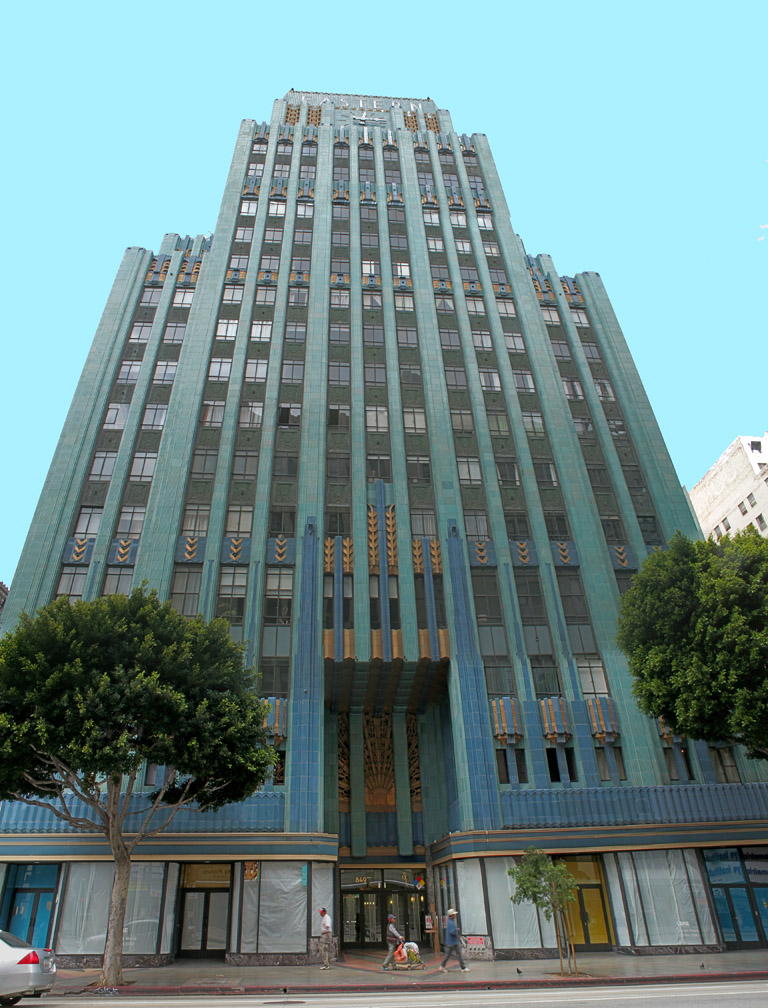
Below is a composite photo of one of the buildings we saw. I took four photos with the camera in panorama (horizontal) moving up the building. In Photoshop I rotated each of them, used File/Automate/Photomerge to put them together, then rotated the image back to normal. The sky was so blown out that I completely replaced it with a single color. Some day I may go back in and insert some clouds.
Hooray, a success. True, only six eventually made it but we came back with a wide variety of photos and a wealth of information about how to get even more.
Many thanks to all those who participated in coming up with the idea, planning it out, reviewing the flyers and postings, and getting the word out. My name may have been on this field trip as the lead but many others participated. Also, many thanks to the LA Conservancy.
Things that went well: The trip went smoothly. We all knew where to go, where to meet, and what trains to catch. The research and printouts from MetroLink and the LA Conservancy were great guides. The LA Conservancy gave us our own docent (guide) who was knowledgeable and patient.
Things that could be improved:
- We checked our camera settings on the MetroLink down which was a good thing. Unfortunately I forgot to check my lens, which was set to Manual Focus, so only one of my group photos came out, and then only by a nose. We also played with some of the settings which I was unfamiliar with so some of my photos came out B/W. Which worked out for the better.
- In the subway we took all kinds of photos until a gang of six employees came up and explained that we were not to be taking photos of the tracks or trains. Some kind of security thing. But they didn't ask us to delete any of what we took.
- I had purchased three tour tickets on the internet, two adults and one child. When I checked in their computer list had only the adults. Fortunately I had my confirmation printed out to show them so I didn't have to repay for Julia. On the other hand, we had brought Reyanne with us and were able to buy her a ticket on the spot.
- Throughout the trip I kept getting fuzzy photos, though I couldn't tell from my camera's LCD. The morning was cloudy and the light was dim. I knew that my exposure times were much longer than recommended but I didn't want to push the ISO to the max or open the aperature too far, though I should have. After looking at Julia's photos from her P&S set to Auto I now believe that, during the cloudy morning, I probably would have gotten better photos going with Auto or Program (to kill the flash). We really couldn't have gotten away with using tripods even though that would have been a good solution.
Future trips: Besides taking more of the LA Conservancy guided tours I would like to go back to Pershing Square with a telephoto lens and a tripod to capture much of the detailed artwork on the buildings in the area. There must be hundreds of different architectural styles and designs. Pershing Square itself has enough varied architecture, such as the waterfall and giant balls, to be a good place to do outdoor portrait photography. And then there are all the interesting characters who are denizens of the streets.
Below is a composite photo of one of the buildings we saw. I took four photos with the camera in panorama (horizontal) moving up the building. In Photoshop I rotated each of them, used File/Automate/Photomerge to put them together, then rotated the image back to normal. The sky was so blown out that I completely replaced it with a single color. Some day I may go back in and insert some clouds.
Most of the photos Deborah, Julia, and I submitted didn't get posted on the LPA web site but if you're interested you can find them on my web site at http://www.glenn-olson.com/photos/blogs/laft/laft.htm.
I don't have a location for photos by Lee and Terri.
I don't have a location for photos by Lee and Terri.
12 posts :: Page 1 of 1
Next Competition
Date: 20-Oct
Venue: AV Senior Center
Theme: Travel
Submission Deadline:
13-Oct 11:59PM
13-Oct 11:59PM


Jim & Cheryl Ross